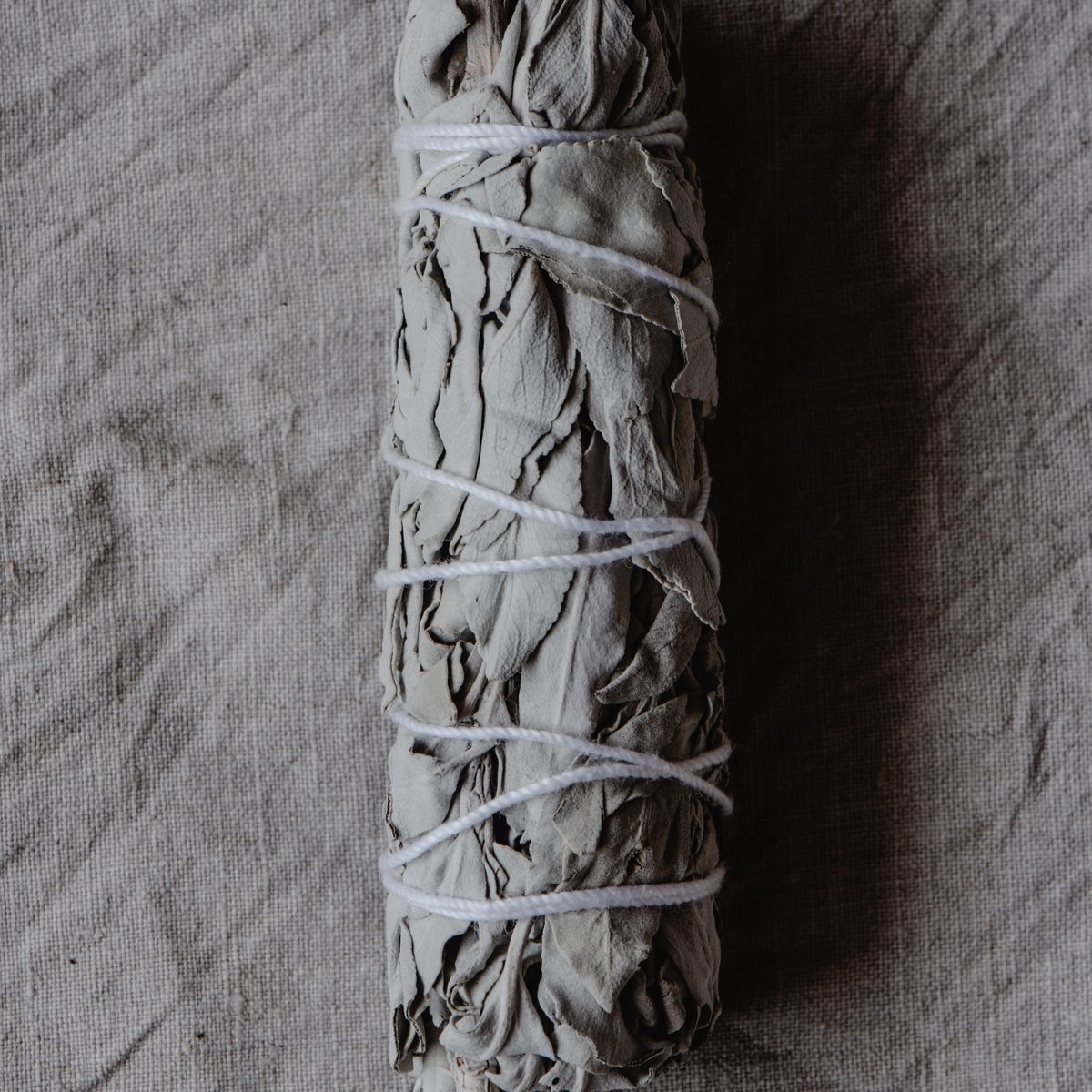
Bouquets de sauge blanche séchée sur fond clair

Silvery and powerful, the plant of the American great outdoors

White Sage: Origin, History, Symbolism, and Tradition

White sage is an aromatic shrub native to California, recognizable by its downy, silver-green leaves and powerful, woody scent.

White sage in brief

Botanical family Lamiaceae
Botanical name Salvia apiana
Part used Dried leaves, often in braided bundles
Main active compounds Cineole, camphor, thujone
Color / appearance Silvery-green, downy leaves
Main origin California, southwestern United States, northern Mexico

History

White sage grows wild in the arid regions of the American Southwest and Northern Mexico. Indigenous peoples in these areas traditionally used it to perfume spaces and objects, a practice passed down through generations. Its growing international popularity since the 2000s has raised concerns about the overexploitation of wild plants and respect for the communities from which it originates.

Bouquet de sauge blanche tressé

Virtues & Symbolism according to Tradition

Traditional Mental Uses

Traditionally, white sage is associated with mental clarity and the symbolic purification of space. It is believed to have the ability to dispel muddled thoughts and to support new beginnings.

Traditional Physical Uses

Internal dimension (tradition)

In traditional representations of the energy body, white sage is associated with the crown chakra, a symbol of clarity and renewal.

Associated element(s)

In ancient botanical traditions, white sage is associated with the element Air, linked to the light smoke it gives off—a symbolic association to be taken as a nod rather than a rule.

Associations

White sage is traditionally combined in different ways depending on the desired effect:

For soothing and stability:
– Palo Santo: a very common combination for symbolically purifying a space
– Rosemary: traditional booster for clarity

For renewal:
– Lemon: complementary freshness
– Lavender: complementary soothing

Symbolism

  • Mental clarity
  • Symbolic purification
  • Renewal
  • New beginnings

Traditions

Do not confuse with

White sage (Salvia apiana) is sometimes confused with common sage (Salvia officinalis), used in European cuisine; white sage has thicker, more silvery leaves and a stronger, woodier scent than classic culinary sage.

Best Provenances

California remains the historical benchmark, particularly in areas where sustainable farming programs have been developed to protect wild populations.

Frequently Asked Questions

Why do we talk about the overharvesting of white sage?

Its growing international popularity since the 2000s has greatly increased demand, while the plant naturally grows in limited quantities in restricted arid areas.

What is the difference between white sage and common sage?

White sage has thicker, silvery leaves with a strong woody fragrance, while common sage, used in European cuisine, has a milder, culinary fragrance.

How to recognize quality white sage?

A well-dried bunch has intact, silvery leaves and releases a powerful fragrance as soon as you lightly rub it between your fingers.

Does white sage grow easily outside of California?
It can be cultivated in similar Mediterranean climates, but it remains naturally associated with the arid zones of the American Southwest where it grows wild.

Sauge blanche séchée sur tissuBouquet de sauge blanche sur plateauSauge blanche séchée sur tissuBouquet de sauge blanche sur plateau

Did you know?

In English, dried white sage bundles are called "smudge sticks," a term that has come to refer more broadly to any dried plant intended to be burned in a small bundle.

Sources & references

Information cross-referenced from general botany works and resources on traditional aromatic plants.

The information presented here is for cultural and traditional purposes only. It does not constitute medical advice or a guarantee of therapeutic effect. In case of physical or psychological distress, consult a healthcare professional. This is especially important during pregnancy, breastfeeding, ongoing medical treatment, or for use in children.