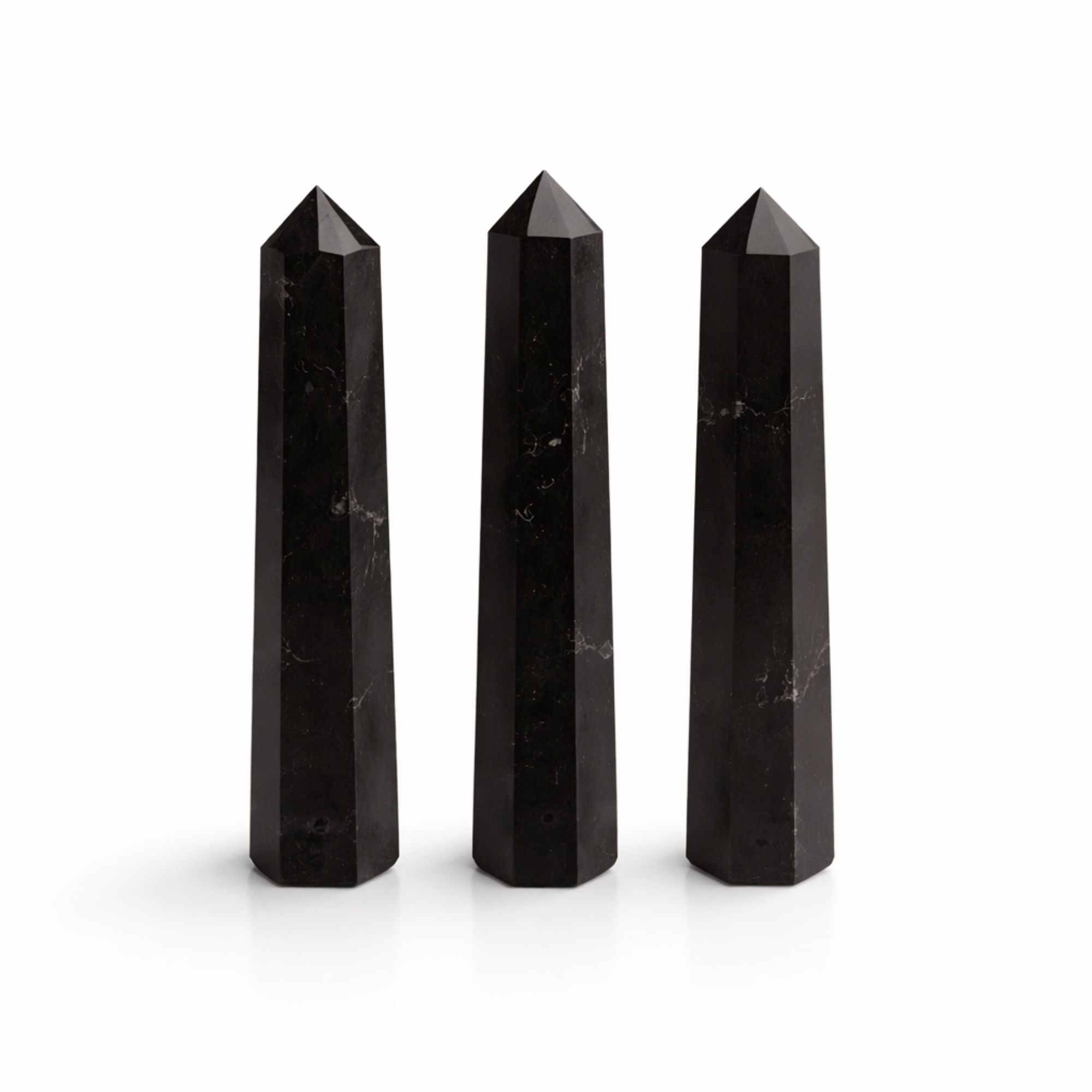
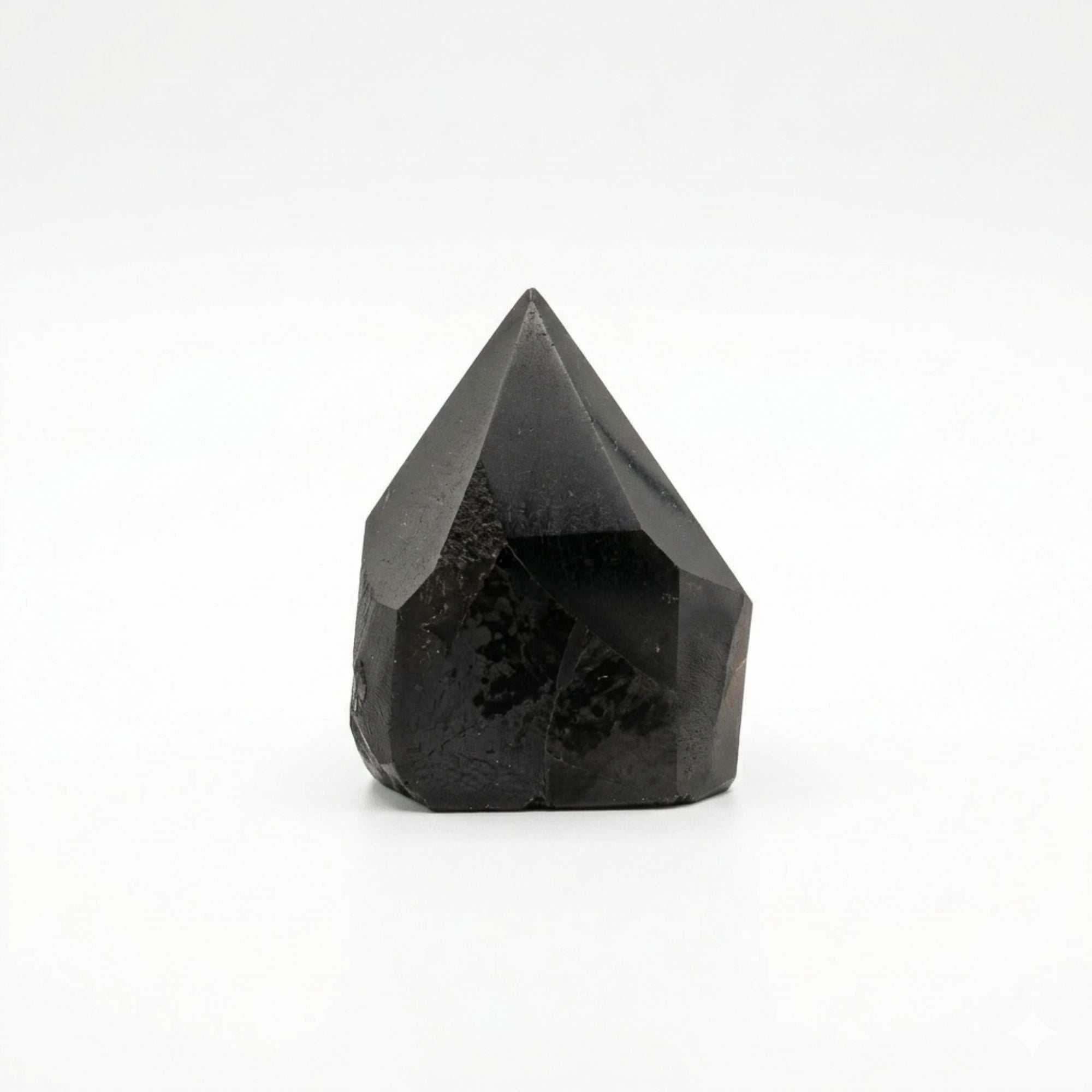
Black and dense, the protective stone par excellence

Black Tourmaline: Origin, History, Symbolism, and Tradition

Black tourmaline, or schorl, is the most common variety of the tourmaline group, recognizable by its opaque deep black color and characteristic longitudinal striations.

Black Tourmaline at a Glance

Mineral group Tourmaline (schorl variety)
Composition Borosilicate of aluminum, sodium, and iron
Hardness 7 to 7.5 on the Mohs scale
Crystal system Trigonal
Colors Deep opaque black
Main origin Brazil, United States, Namibia, Madagascar

History of the stone

The name “tourmaline” comes from the Sinhalese word “turmali,” a term used by Sri Lankan gem merchants to refer to multi-colored gemstones. The stone was largely popularized in the 19th century thanks to the discovery of its piezoelectric and pyroelectric properties: it generates an electric charge when heated or subjected to pressure, a phenomenon documented as early as the 18th century in Europe and exploited in some scientific measuring instruments in the 19th and 20th centuries.

Origin & Composition

Black tourmaline, also known as schorl, is a complex iron-rich borosilicate, which gives it its characteristic opaque black hue. It is the most common variety of the tourmaline group. It forms in granitic pegmatites, often as elongated crystals with visible longitudinal striations on their surface.

Virtues & Symbolism According to Tradition

Traditional Mental Uses

Traditionally, black tourmaline is associated with protection and grounding. It is believed to ward off negative thoughts and anxiety, strengthen inner security, and aid concentration by dispelling mental distractions. It is considered one of the most frequently cited protective stones in contemporary decorative traditions.

Traditional physical uses

Internal dimension (tradition)

In traditional representations of the energetic body, black tourmaline is associated with the root chakra, symbolizing protection and deep anchoring.

Associated astrological sign(s)

In some Western traditions, black tourmaline is sometimes associated with the zodiac signs of Capricorn and Scorpio—a symbolic association to be taken as a nod rather than a rule.

Stone associations

Black tourmaline is traditionally combined in different ways depending on the desired effect:

For protection:
– Obsidian: classic protection duo
– Hematite: enhanced grounding

For concentration:
– Sodalite: mental clarity
– Fluorite: thought structuring

Interview

Physical cleaning: rinsing with clear water and a soft cloth is sufficient. With a hardness of 7 to 7.5 on the Mohs scale, black tourmaline is very resistant and perfectly suited for daily use.

Symbolism

  • Protection
  • Grounding
  • Inner security
  • Concentration

Traditions

Do not confuse with

Black tourmaline is sometimes confused with onyx or obsidian due to its color. It is distinguished by its characteristic longitudinal striations visible on its surface and its irregular fracture, unlike the smoother surface of polished onyx or the conchoidal fracture of obsidian.

Top provenances

Brazil is the world's leading producer of black tourmaline, followed by the United States and Madagascar.

Frequently Asked Questions

What is tourmaline piezoelectricity?

This is the ability of the stone to generate an electrical charge when subjected to mechanical pressure, a property studied scientifically since the 19th century and used in certain measuring instruments.

Where does the name "tourmaline" come from?

It comes from the Sinhalese "turmali", a term used by Sri Lankan gemstone merchants to designate multi-colored gems.

How to identify natural black tourmaline?

It usually has characteristic longitudinal striations visible on its surface and an irregular fracture, unlike the smoother surface of polished onyx.

Is black tourmaline durable?

Yes, with a hardness of 7 to 7.5 on the Mohs scale, it is perfectly suitable for daily use in jewelry.

Did you know?

Tourmaline has the particularity of generating an electric charge when heated or subjected to pressure, a property that allows it to attract small fragments of dust or paper, a phenomenon observed and documented in Europe as early as the 18th century.

Sources & References

Information gathered from general gemology works and Earth Sciences museum resources (Muséum national d'Histoire naturelle, reference works in mineralogy).

The information presented here is for cultural, historical, and decorative purposes only. It does not constitute medical advice or a guarantee of therapeutic effect. In case of physical or psychological distress, consult a healthcare professional.