Golden and metallic, stone of abundance and action

Pyrite: Origin, History, Symbolism, and Tradition

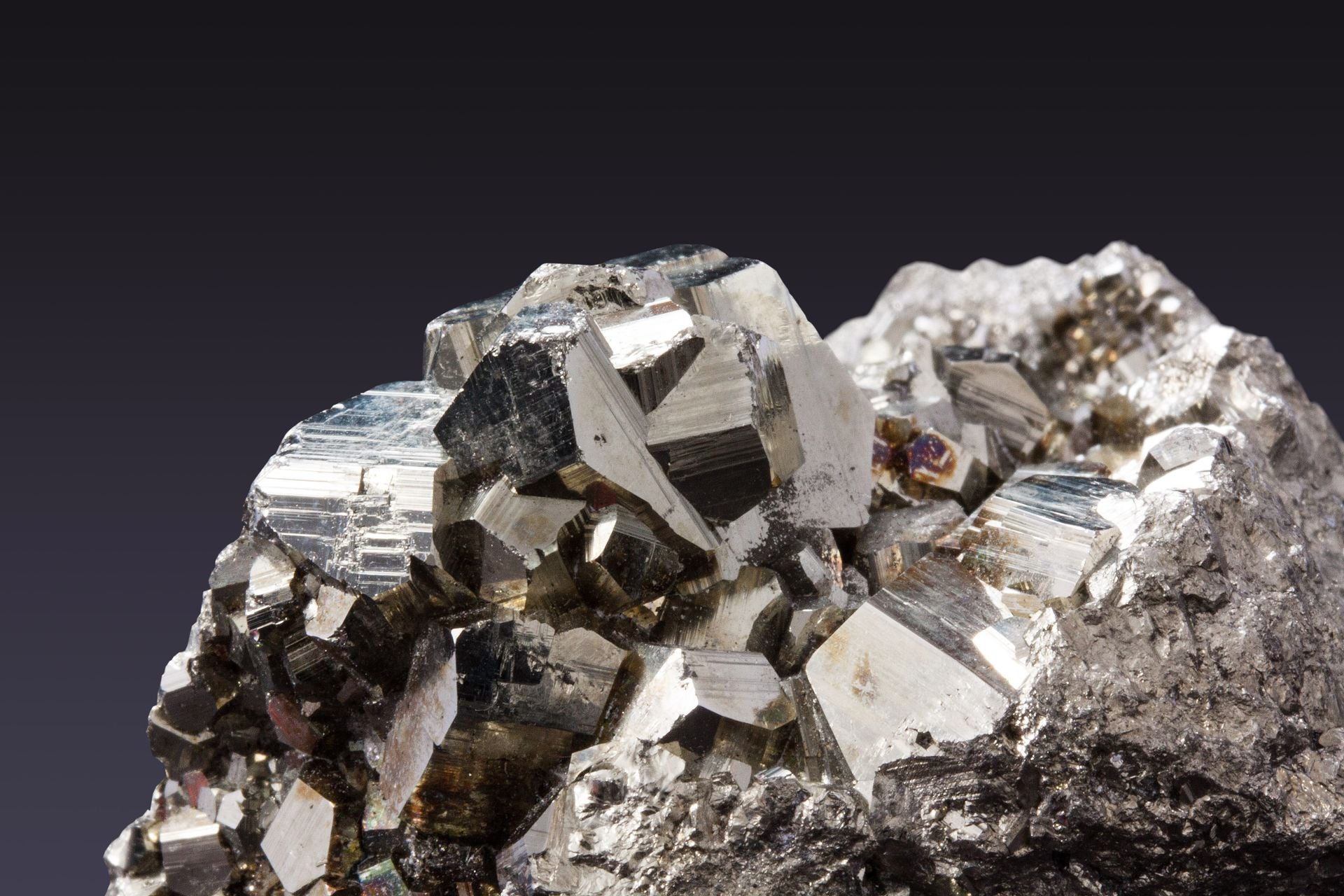
Pyrite is an iron sulfide recognizable by its golden metallic luster and perfect cubic crystals, nicknamed "fool's gold" due to its deceptive resemblance to real gold.

Pyrite at a glance

Mineral Group Iron sulfide
Composition Iron disulfide (FeS₂)
Hardness 6 to 6.5 on the Mohs scale
Crystal System Cubic
Colors Metallic golden yellow, brilliant appearance
Main Origin Peru, Spain, United States, China

History of the stone

The name "pyrite" comes from the Greek "pyr" (fire), as the stone produces sparks when struck against flint or steel, a property used since prehistoric times to light fires. Pre-Columbian civilizations, particularly the Incas, fashioned it into polished mirrors. Its deceptive resemblance to gold earned it the nickname "fool's gold," misleading many gold prospectors throughout history, especially during the 19th-century American Gold Rush.

Origin & Composition

Pyrite is an iron sulfide that forms in various geological environments (sedimentary, hydrothermal, metamorphic). It frequently crystallizes into perfect cubes due to its natural cubic crystal structure, making it a highly sought-after collector's item among mineralogists.

Virtues & Symbolism According to Tradition

Traditional Mental Uses

Traditionally, pyrite is associated with self-confidence, abundance, and determined action. It is believed to stimulate motivation, strengthen perseverance in the face of obstacles, and support the realization of professional and personal projects. It is often linked to material success and the ability to attract opportunities.

Traditional physical uses

Internal dimension (tradition)

In traditional representations of the energy body, pyrite is associated with the solar plexus chakra, a symbol of personal strength and self-assertion in action.

Associated astrological sign(s)

In some Western traditions, pyrite is sometimes associated with the zodiac signs Leo and Aries—a symbolic association to be taken as a nod rather than a rule.

Stone associations

Pyrite is traditionally combined in different ways depending on the desired effect:

For abundance and success:
– Citrine: traditional duo associated with prosperity
– Aventurine: strengthens luck and opportunities

For determination:
– Tiger's Eye: complementary action and courage
– Garnet: strength of character and perseverance

Interview

Dry clean preferably, with a soft cloth. Avoid water and prolonged moisture, which can oxidize the stone and dull its characteristic metallic luster, as well as harsh chemicals.

Symbolism

  • Self-confidence
  • Abundance
  • Determined action
  • Perseverance

Traditions

Do not confuse with

Pyrite is sometimes mistaken for real gold due to its metallic golden luster, hence its nickname "fool's gold". It is distinguished by its higher hardness, more brittle splintering fracture, and a much lower density than gold, which is much heavier and malleable.

Top provenances

Peru is known for its perfect pyrite cubes, highly sought after by collectors, while Spain (Navajun) produces exceptional crystals.

Frequently Asked Questions

Why is pyrite nicknamed "fool's gold"?

Due to its deceptive resemblance to gold, which misled many gold prospectors throughout history, particularly during the American gold rush of the 19th century.

How to distinguish pyrite from real gold?

Pyrite is harder but breaks into splinters, and its density is much lower than that of gold, which is much heavier and more malleable.

Why does pyrite form perfect cubes?

Its natural cubic crystalline structure allows it to grow spontaneously in this geometric shape, making it a highly sought-after collector's item.

How to care for pyrite?

Dry cleaning with a soft cloth is preferable; avoid water and prolonged moisture, which can oxidize it and dull its characteristic metallic shine.

Did you know?

The name "pyrite" comes from the Greek "pyr" (fire), because the stone produces sparks when struck against flint or steel — a property used since prehistoric times to start fires, long before the invention of matches.

Sources & References

Information cross-referenced from general gemology texts and Earth sciences museum resources (National Museum of Natural History, reference works in mineralogy).

The information presented here is for cultural, historical, and decorative purposes only. It does not constitute medical advice or a guarantee of therapeutic effect. In case of physical or psychological distress, consult a healthcare professional.