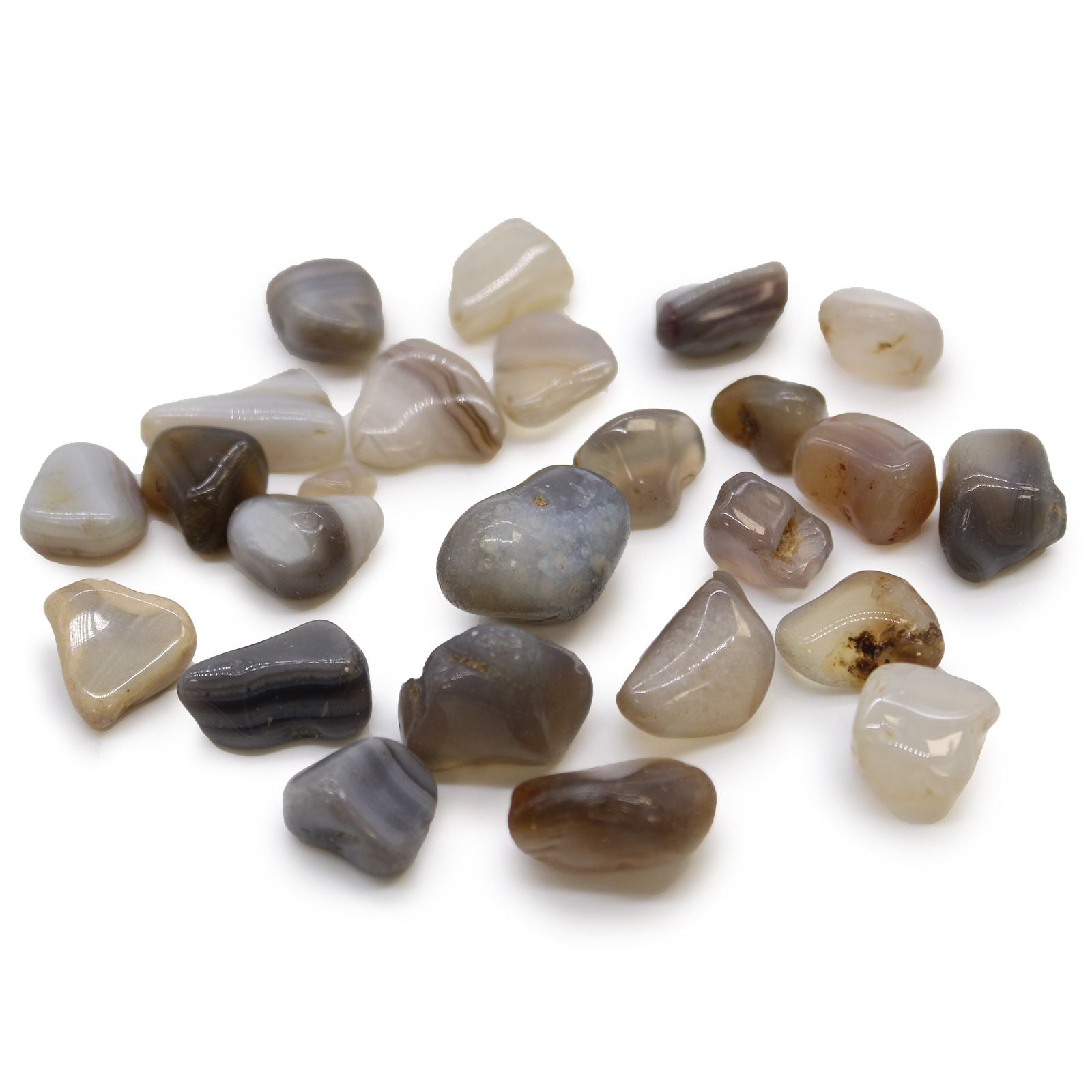
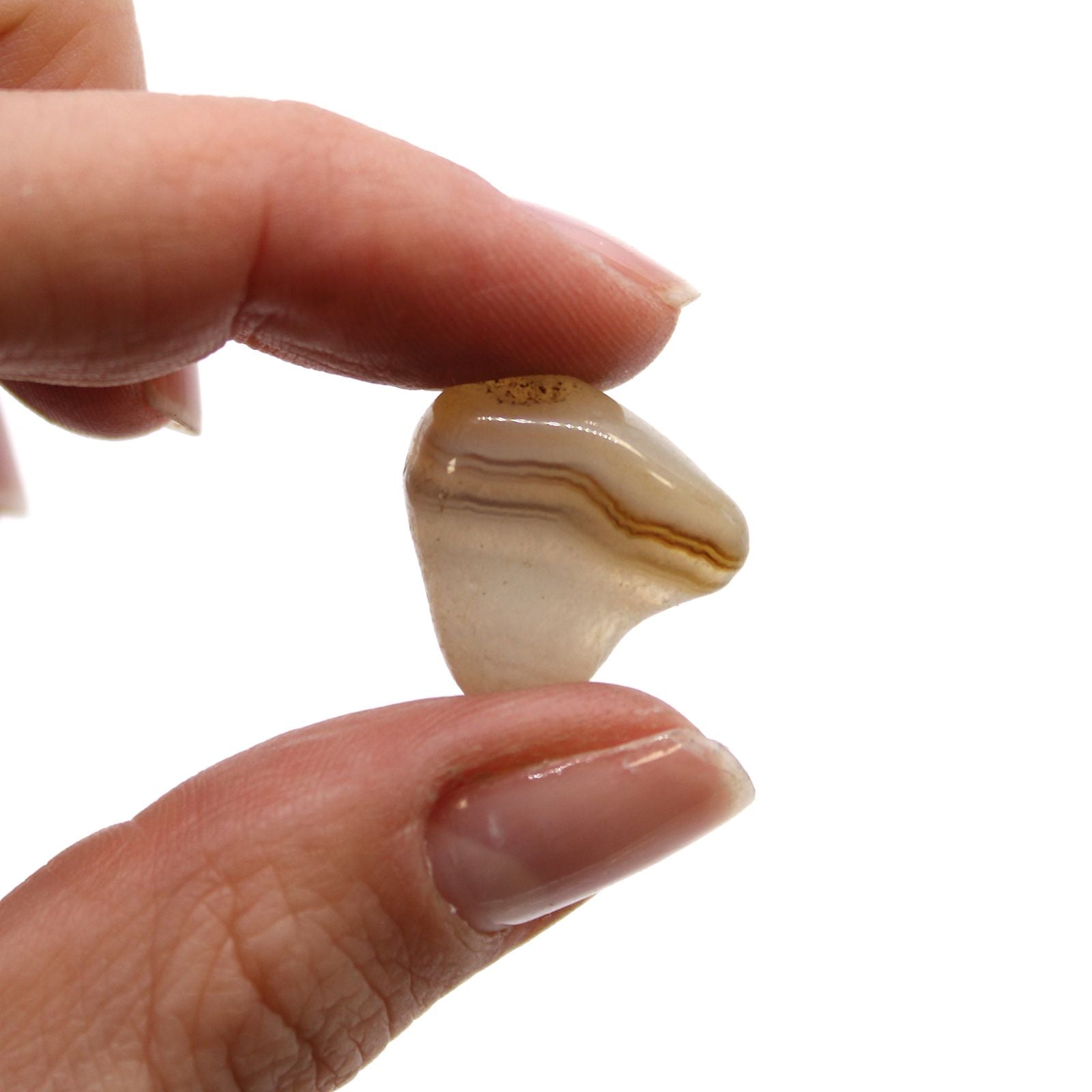
Tranche de géode d'agate bleue sur tissu blanc

Natural stripes, softness and diversity

Agate: Origin, History, Symbolism, and Tradition

Agate is a variety of chalcedony, itself a member of the quartz family, recognizable by its colored concentric bands. These patterns result from successive deposits of silica in rocky cavities, often of volcanic origin.

Agate at a glance

Mineral group Quartz (chalcedony, silicates)
Composition Silicon dioxide (SiO₂), various oxides depending on variety
Hardness 6.5 to 7 on the Mohs scale
Crystal system Trigonal (cryptocrystalline)
Colors Varied concentric bands: white, gray, brown, blue, red
Main origin Brazil, Uruguay, India, Madagascar, Botswana

History of the stone

The name "agate" is thought to come from the Achates River (now Dirillo) in Sicily, where the Greek historian Theophrastus reportedly described this stone in the 4th century BCE. Used since ancient Mesopotamia for making engraved cylinder seals, it also adorned protective amulets in ancient Greece and Egypt. The Romans widely used it for jewelry and engraved intaglios. In the Middle Ages, it continued to embellish both religious and secular objects in Europe.

Origin & Composition

Agate belongs to the chalcedony family, which itself comes from microcrystalline quartz. Its colored bands are the result of successive deposits of silica in rock cavities, often of volcanic origin, with each layer corresponding to a variation in mineral composition or deposition conditions. Brazil and Uruguay supply the famous geodes lined with agate; India and Madagascar produce varieties with softer hues.

Virtues & Symbolism According to Tradition

Traditional Mental Uses

Traditionally, agate is worn to promote emotional stability and self-confidence. It is believed to have the ability to soothe fears and temporary anxiety, support decision-making, and help navigate periods of change with greater serenity.

Traditional physical uses

Internal dimension (tradition)

In traditional representations of the energetic body used in Zen decoration, agate is associated with the root chakra, symbolizing grounding and stability — a cultural and aesthetic association, not a physical property of the stone.

Associated astrological sign(s)

In some Western traditions, agate is associated with the signs Gemini and Virgo — a calendrical and symbolic association to be taken as a nod rather than a rule.

Stone associations

Agate is traditionally combined in different ways depending on the desired effect:

For grounding and stability:
– Obsidian: reinforces protection and earthly grounding
– Hematite: provides structure and inner strength
– Red Jasper: offers vitality and complementary rooting

For softness and emotional balance:
– Rose Quartz: a classic combination for soothing the heart
– Aventurine: shared balance and lightness
– Amazonite: promotes calm communication and relational harmony

Interview

Physical cleaning: a rinse with clear water and a soft cloth are sufficient. Agate tolerates sunlight well without color alteration, except for artificially dyed stones, which may fade.

Energetically, some traditions recommend passing it under running water or placing it on a cluster of quartz to "revitalize" its perceived energy – a symbolic and soothing practice, with no measurable physical effect on the stone itself.

Symbolism

  • Balance and stability
  • Symbolic protection
  • Grounding and inner strength
  • Gentleness in the face of daily tensions

Traditions

Do not confuse with

Some agates are artificially dyed to intensify their colors (bright blue, deep purple). A hue that is too uniform and saturated, without gradient or natural banding, can indicate artificial coloring.

Top provenances

Brazil and Uruguay produce agate geodes renowned for their distinct and contrasting bands. Madagascar and India supply agates with softer hues, widely used in jewelry.

Frequently Asked Questions

How to identify natural agate?

It presents irregular concentric bands and natural shades, unlike artificially dyed agates, whose colours are often too uniform and vivid.

Does agate lose its color over time?

No, a natural agate retains its color over time; only artificially dyed stones may fade with prolonged exposure to the sun.

What's the difference between agate and chalcedony?

Agate is a variety of chalcedony characterized by its visible colored bands; plain chalcedony has a more uniform color, with no distinct banding.

Can you wear agate every day?

With a hardness of 6.5 to 7 on the Mohs scale, agate is resistant to daily impacts and suitable for regular wear.

Did you know?

Agates form drop by drop, layer by layer, over thousands of years inside volcanic pockets — each band tells a stage of its formation, much like the rings of a tree.

Sources & References

Information cross-referenced from general gemology works and Earth science museum resources (National Museum of Natural History, reference works in mineralogy).

The information presented here is for cultural, historical, and decorative purposes only. It does not constitute medical advice or a guarantee of therapeutic effect. In case of physical or psychological distress, consult a healthcare professional.