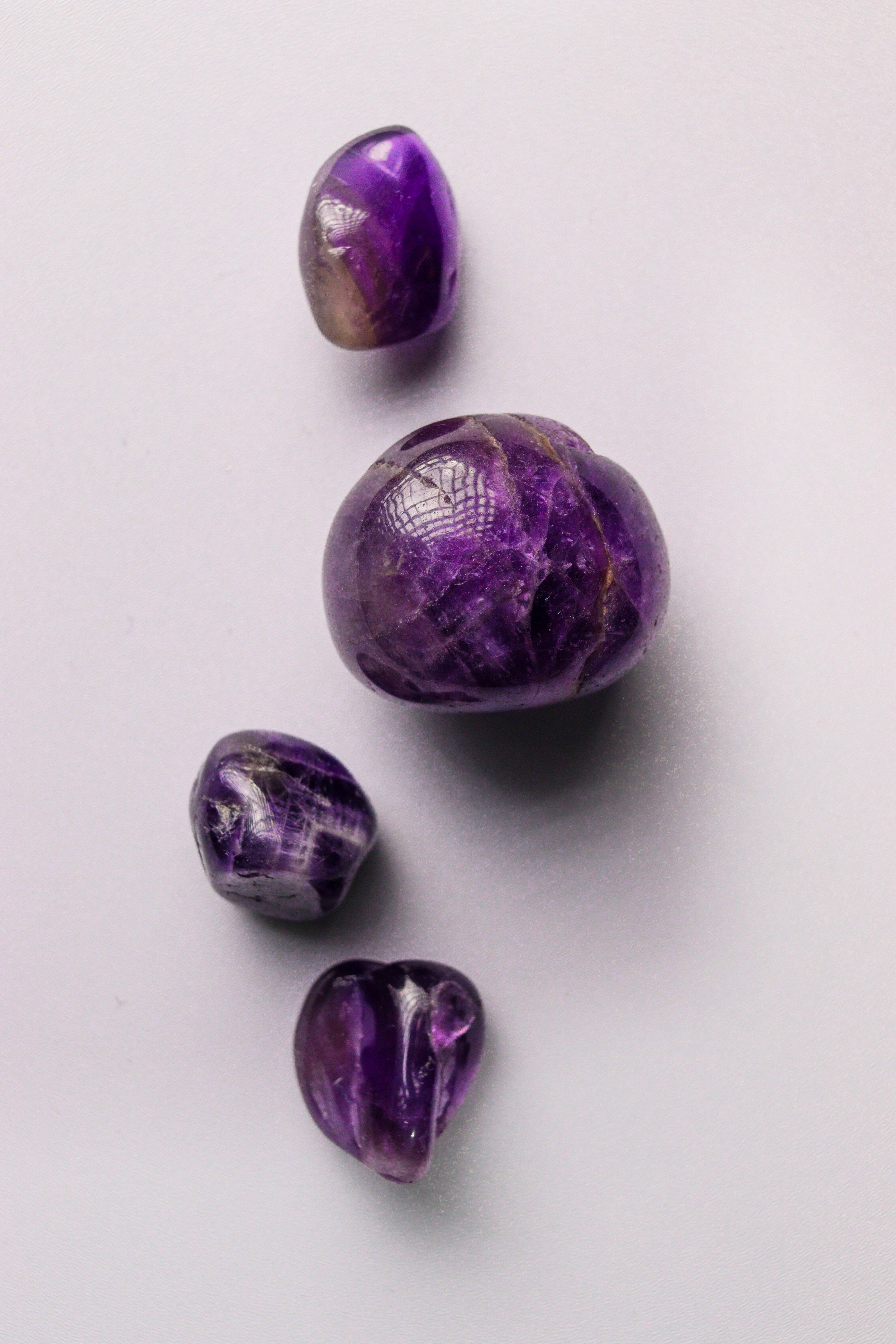
Cristal violet, gemme précieuse d'améthyste

Violet, soothing, timeless

Amethyst: Origin, History, Symbolism, and Tradition

Amethyst is a variety of quartz recognizable by its purple hue, from pale lilac to deep violet. This coloration comes from traces of iron present in the rock during its formation, under the effect of natural radiation.

Amethyst at a glance

Mineral group Quartz (silicates)
Composition Silicon dioxide (SiO₂), traces of iron
Hardness 7 on the Mohs scale
Crystal system Trigonal
Colors Pale violet to deep purple, sometimes zoned
Main origin Brazil, Uruguay, Madagascar, Zambia

History of the stone

The name "amethyst" comes from the ancient Greek *amethystos*, "not drunk": an ancient legend tells that the goddess Artemis transformed a nymph into a purple stone to protect her from the wrath of Dionysus, god of wine — hence the lasting association between this stone and temperance. In ancient Egypt, it was carved into scarabs and funerary beads. In the Middle Ages, it adorned episcopal rings, worn as a symbol of sobriety. During the Victorian era, it experienced a resurgence in Western jewelry.

Origin & Composition

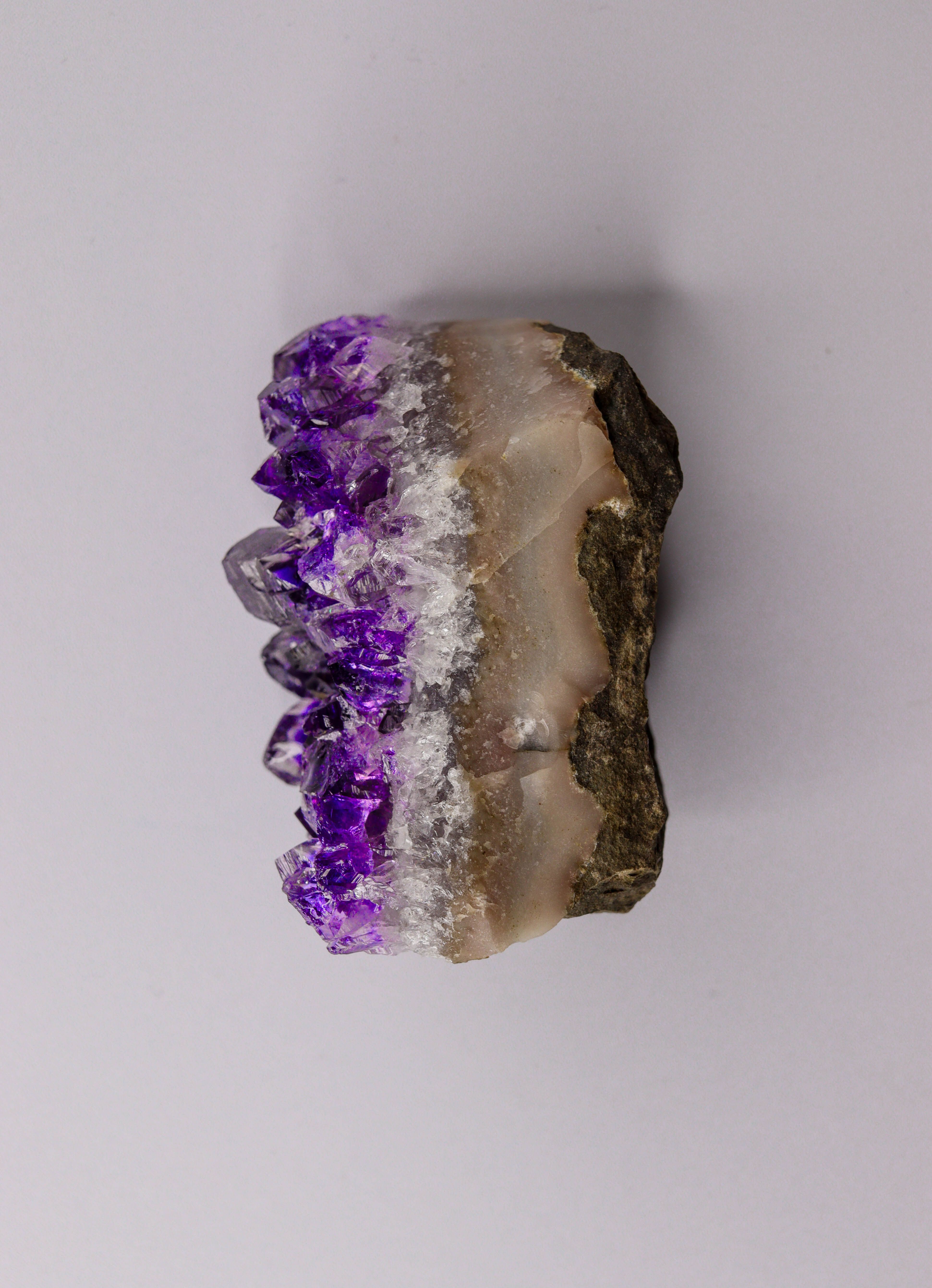
Amethyst belongs to the quartz family, like rock crystal or rose quartz. Its violet color comes from traces of iron integrated into the crystal structure during its formation, combined with natural exposure to telluric radiation over long geological periods. It most often forms in volcanic geodes, where crystals develop as points inside a silica-lined cavity. Brazil and Uruguay provide the famous geodes several tens of centimeters in size; Madagascar and Zambia produce often deeper hues.

Cristal d'améthyste sur fond clair, photo produit

Virtues & Symbolism According to Tradition

Traditional Mental Uses

Traditionally, amethyst is worn to promote concentration, mental clarity, and calm decision-making. It is believed to soothe an agitated mind, quiet intrusive thoughts, and support reflection during times of tension or overwork. Some traditions also recommend it for periods of learning or extended meditation.

Traditional physical uses

Internal dimension (tradition)

In traditional representations of the energy body used in Zen decor and yoga, amethyst is associated with the crown chakra, a symbol of calm and personal elevation — a cultural and aesthetic association, not a physical property of the stone.

Associated astrological sign(s)

In certain Western traditions, amethyst is associated with the sign of Pisces and considered the birthstone for February—a calendrical and symbolic association to be taken as a nod rather than a rule.

Stone associations

Amethyst is traditionally combined in different ways depending on the desired effect:

For calm and mental clarity:
– Selenite: a duo traditionally associated with the symbolic purification of surrounding energy
– Lepidolite: enhances appeasement, a stone also rich in natural lithium
– Fluorite: structuring of thought and clarity of judgment

For inner elevation and meditation:
– Clear Quartz: traditional amplification of intentions set during meditation
– Labradorite: ancient association with intuition and symbolic protection
– Citrine: complementary balance between calm and joy of life, a duo sometimes called ametrine when the two stones are naturally combined in the same crystal

Interview

Physical cleaning: a rinse with clear water and a soft cloth are sufficient to dust the stone. Avoid prolonged exposure to direct sunlight, which can diminish the violet color over time.

On an energetic level, some traditions recommend leaving the stone out in moonlight to "reset" its perceived energy after a period of intensive use—a symbolic and soothing practice to incorporate if it resonates with you, with no measurable physical effect on the stone itself.

Symbolism

  • Calmness and peace of mind
  • Mental clarity and reflection
  • Temperance and moderation
  • Personal elevation in certain meditative practices

Traditions

Do not confuse with

Purple tinted glass is sometimes sold as “amethyst” at a low price. A natural stone usually has irregular color zoning and slight inclusions, whereas glass has a perfectly uniform hue and a transparency that is too “clean.”

Top provenances

Brazil and Uruguay are renowned for their spectacular geodes, while Zambia produces stones of particularly dense and uniform color, highly sought after in jewelry.

Frequently Asked Questions

How to recognize a real amethyst?

It often exhibits irregular color zoning and slight inclusions, unlike tinted glass which has perfectly uniform color.

Does amethyst lose its color over time?

Yes, prolonged and intense exposure to sunlight can fade its purple hue.

What is the difference between amethyst and ametrine?

Ametrine is a single stone exhibiting both a purple zone (amethyst) and a yellow zone (citrine) within the same crystal.

Can amethyst be worn every day?

With a hardness of 7 on the Mohs scale, amethyst is well-suited to withstand daily wear and tear. You just need to avoid prolonged contact with harsh chemicals (perfume, household cleaners) that can dull its surface.

Pierres d'améthyste violettes éclatantes sur fond clairCristal d'améthyste sur fond clairPierres d'améthyste violettes éclatantes sur fond clairCristal d'améthyste sur fond clair

Did you know?

The largest amethyst geode ever mined is several meters high and weighs several tons—some are now on display in natural science museums around the world.

Sources & References

Information cross-referenced from general gemology works and Earth sciences museum resources (Muséum national d'Histoire naturelle, reference works in mineralogy).

The information presented here is for cultural, historical, and decorative purposes only. It does not constitute medical advice or a guarantee of therapeutic effect. In case of physical or psychological distress, consult a healthcare professional.